
Drilling in hard and brittle materials such as porcelain ggres or ceramic tiles requires not only precision, but above all appropriate tools. The choice of the wrong fitting can lead to frustrating damage, cracks and unesthetic spatter, destroying expensive linings. The key to success are specialist Grecian and ceramic openingswhich, although seemingly similar, differ in design and destiny. Understanding these differences is fundamental to anyone who wants to get clean and precise holes, regardless of the scale of the project.
Construction of Grecian and Ceramic Holes: Key Differences
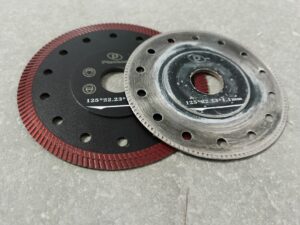
The basic difference between openings designed for gress and those for standard ceramics lies in the material from which their cutting edge was made. Porcelain Gres is a very hard and dense material, with very low soaking capacity, which makes its processing much harder than with smaller ceramic tiles (glazes or terracotta). Therefore, the Grecian openings must be equipped with a cutting segment with a diamond embankment. Two technologies are most commonly used: a galvanic embankment, where diamonds are fixed in one layer, and vacuum soldering, which creates a more durable and efficient binding of diamond grains. In turn soft ceramics are often sufficient for tungsten carbide or simpler diamond embankment, which are less resistant to high temperatures and abrasion.
Comparison of efficiency of different types of openings
The efficiency of the hole depends directly on its construction and purpose. Diamond-to-greet openings, especially those vacuum-throwed, are characterized by a much higher drilling speed and serviceability compared to soft ceramic tools. They allow several dozen holes in the toughest material without losing cutting properties. In turn tungsten carbide holes, although effective in glaze, in contact with the ggres very quickly wear out and overheat. Analyzing Gress drill types and their performance, the geometry of the body should also be taken into account. Side holes facilitate draining and cooling, which also affects the speed and quality of work.
Selection of appropriate rotation and cooling during drilling
Drilling technique is as important as the tool itself. The key parameter is the rotary speed of the drill or angle grinder. For hard grits it is recommended to work at high speeds (commonly above 10,000 rpm for grinding machines). Too much pressure causes the diamond segment to overheat and wear fast. Cooling is another critical factor. We distinguish between wet drilling, with continuous water supply and dry drying. Dry bores often use cooling wax integrated in the body of the tool, which melts during operation, lubrication and cooling cutting edge. For soft ceramics these parameters are less stringent, and work can often take place at lower speeds and without specialized cooling.
How to avoid chipping while drilling in plates
The spatter on the edge of the hole is the most common problem when working with tiles. In order to avoid it, there are a few rules that must be respected. First of all, never start drilling perpendicularly to the surface of the tile. Instead, the opening should be applied at a slight angle (approximately 30 degrees) and after a small crescent-shaped incision, gradually straighten the tool to the perpendicular position. This technique prevents the opening from sliding on a smooth surface and minimises the risk of cutting edges. It is also crucial to perform delicate circular movements while drilling. This not only improves cooling, but also facilitates removal and provides an equal finish. Using these methods is the best answer to the question, How to drill in a gres without chipping.
Drilling technique: key to a clean hole
To guarantee a clean and precise opening each time, it is worth following the proven steps. The correct technique is the foundation of success, especially when working with such demanding material as ggres.
- Stability: Make sure the plate is firmly attached and does not vibrate during operation.
- Start at: Start drilling by applying the hole at an angle to the surface of the plate to create a attachment point.
- Gradual straightening: After making the incision, slowly and smoothly proceed to the perpendicular drilling.
- Orbital movement: Make gentle circular movements with a drill or grinder. This improves cooling and dust removal.
- Pressure control: Use the minimum pressure – let the diamonds and gear turns do the work.
- Flight drilling: As you approach the plate pierce, reduce the pressure to avoid chipping the bottom edge.
Practical tips: drilling in gres and ceramics step by step
In summary, the process of drilling in tiles can be taken in several simple steps. First, accurately mark the opening. Second, select the right tool – diamond Grecian and ceramic openings for hard materials or with soft tungsten carbide. Thirdly, attach the hole to the device ( drill or grinder) and set the recommended rotations. The fourth step is to apply the right technique: start at an angle, then orbital movements with minimal pressure. Remember to cool if required by the opening manufacturer. Finally, after the plate has been pierced, clean the hole of dust and property. Applying these guidelines, even the difficult task of drilling in Gresa will become predictable and will end with a professional result.